

Introduction: Why AEO Strategies Matter in 2025
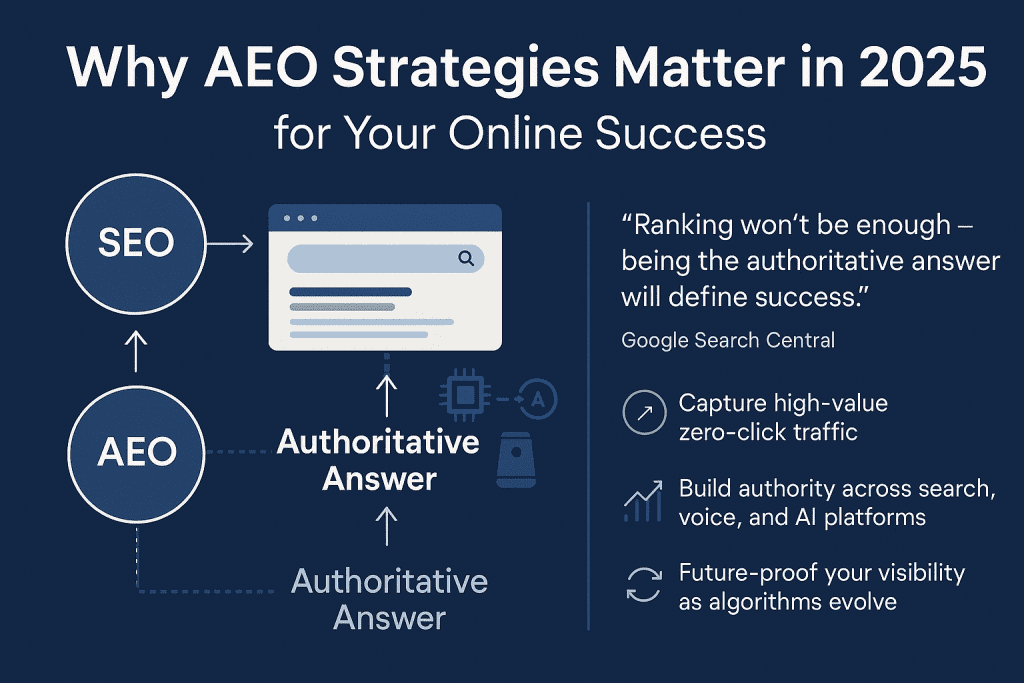
If you’ve noticed search results looking different lately, you’re not imagining things. In 2025, the competition isn’t just other websites — it’s AI-powered search engines that aim to give users answers instantly, often without a single click. That’s where an AEO Strategy (Answer Engine Optimization) becomes a game-changer for your online success.
Unlike traditional SEO, which focuses on ranking higher for keywords, AEO Strategies focus on making your content the definitive answer that Google, Bing, and voice assistants trust. This means your business can show up in AI-generated summaries, featured snippets, and voice search results — places where customers are now spending the majority of their attention.
The truth is, if you’re still playing by the old SEO rulebook, you’re leaving visibility — and revenue — on the table. With the right AEO Strategy, you’re not chasing clicks, you’re earning authority.
Expert Insight
“Ranking won’t be enough — being the authoritative answer will define success.” — Google Search Central
Anchor Cluster Link: Learn more in — Mastering AEO Strategies for SEO Dominance in 2025 — for in-depth, step-by-step tactics.
Why it matters for your business:
- Capture high-value zero-click traffic.
- Build authority across search, voice, and AI platforms.
- Future-proof your visibility as algorithms evolve.
Official External Source: U.S. General Services Administration – Digital.gov
Table of Contents
Understanding AEO Strategies: The Future of Search
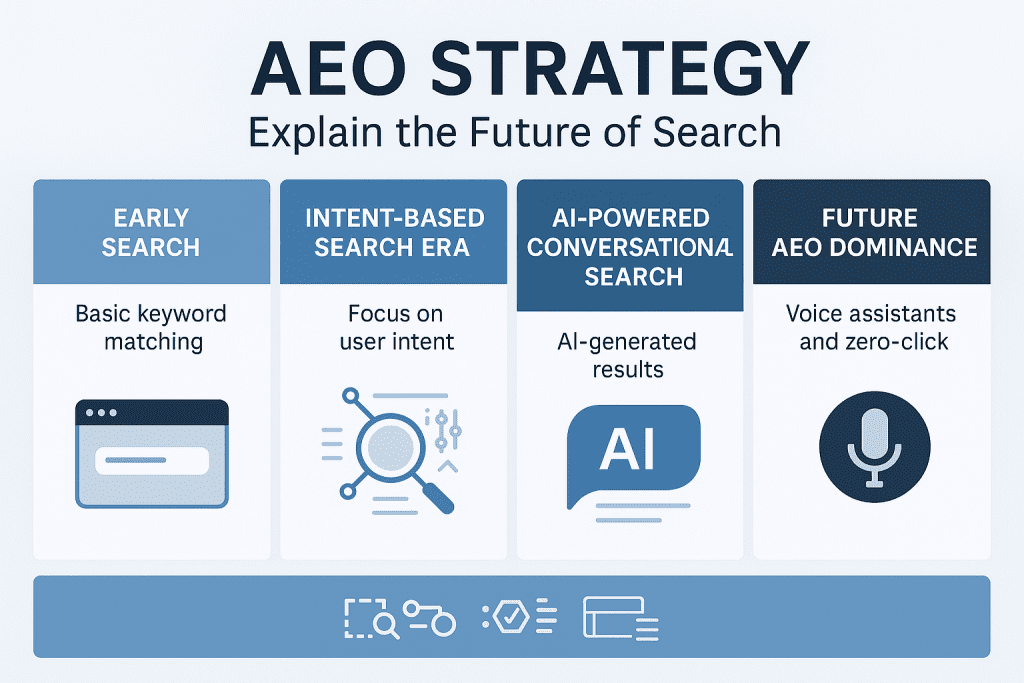
The future of search is rapidly shifting from keyword-driven rankings to Answer Engine Optimization (AEO), where success means being the definitive answer for AI-driven, voice-enabled, and conversational queries. Unlike traditional SEO, an AEO Strategy focuses on structuring content so search engines and AI assistants can instantly deliver accurate, concise, and trusted answers. As Google’s Search Generative Experience (SGE) continues to evolve, brands that adapt early will gain long-term visibility even in a zero-click world. By leveraging entity-based content, schema markup, and conversational Q&A formats, you position your site as a reliable knowledge source for both humans and AI.
Expert Insight
“In the next few years, ranking won’t be enough — being the authoritative answer will define success.” — Google Search Central
Key elements for a future-proof AEO Strategy:
- Build E-E-A-T credibility with verified authors and authoritative sources.
- Structure answers in 35–50 word blocks for AI clarity.
- Use FAQ & HowTo schema for answer discoverability.
- Optimize for multi-format search (text, image, video, and voice).
- Refresh content quarterly with fact updates and new queries.
Anchor Cluster Link: See our in-depth guide — Mastering AEO Strategies for SEO Dominance in 2025 — to explore detailed tactics and advanced case studies.
The 7 Proven AEO Strategies to Dominate SEO in 2025
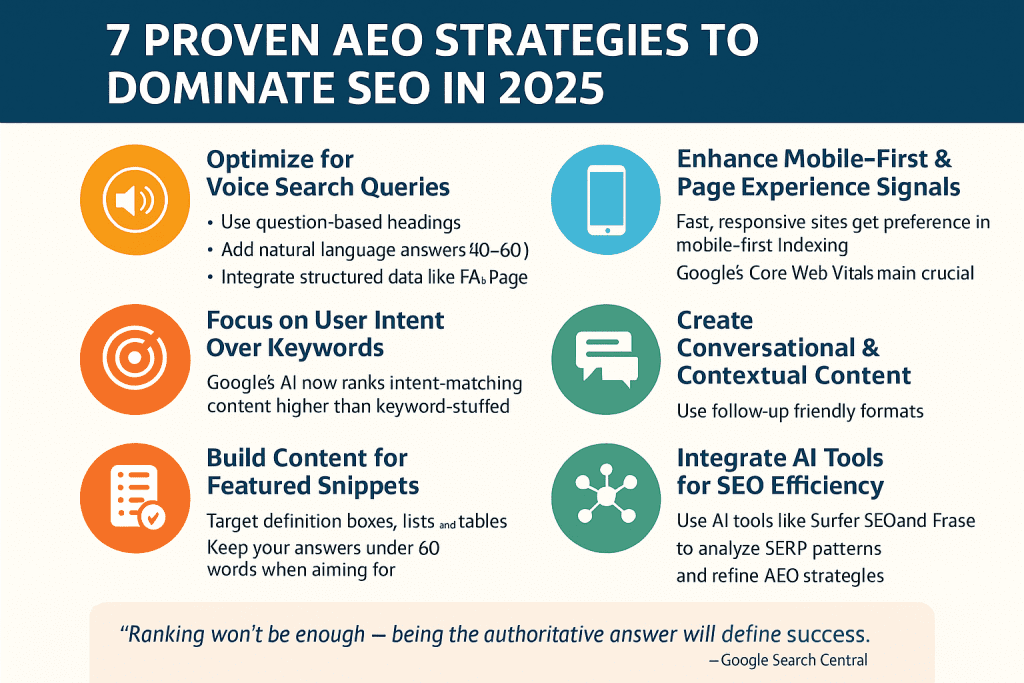
The search landscape in 2025 is driven by AI, voice search, and zero-click results. To stay visible, you need an AEO Strategy (Answer Engine Optimization) that makes your content the go-to answer search engines and AI assistants deliver. Below are seven proven strategies, enriched with guidance from Google and other Tier-1 sources, to help you win the future of search.
Strategy 1: Optimize for Voice Search Queries
Voice search queries are longer and more conversational than typed searches. Instead of “AEO definition,” a voice user might say:
“What are the best AEO strategies for ranking in AI search results?”
Google recommends structuring your answers so they are concise and conversational (Google Search Central – Voice Search).
Action Tips:
- Use question-based headings that mirror how people speak.
- Provide natural language answers (40–60 words).
- Implement FAQPage schema to make answers AI-friendly.
Strategy 2: Leverage Structured Data for AI Search
Structured data (schema markup) helps AI understand your content’s context, increasing your chances of selection as a trusted source.
Google’s official guidance on schema types includes:
- FAQPage — for direct Q&A visibility.
- HowTo — for step-by-step results in search.
- Article — for news/blog content with entity recognition.
Reference: Google Search Central – Structured Data
Strategy 3: Focus on User Intent Over Keywords
Google’s AI favors intent-matching content over keyword-stuffed posts. Understanding why a user searches is key.
Tip from Digital.gov: Map queries to user needs and create resources that solve them (Digital.gov – Content Strategy).
Use tools like “People Also Ask” to anticipate intent and build topical authority.
Strategy 4: Build Content for Featured Snippets
Featured snippets dominate the top of SERPs and voice assistant responses.
Google’s own research shows well-structured, direct answers are more likely to be chosen for snippets (Google Search – Featured Snippets).
Best Practices:
- Keep answers under 60 words.
- Use numbered lists for steps.
- Place definitions immediately after headings.
Strategy 5: Enhance Mobile-First & Page Experience Signals
Mobile-first indexing and Core Web Vitals are still essential for visibility.
Google recommends (Page Experience Guide) ensuring:
- Load speed under 2.5 seconds.
- Responsive design for all devices.
- Stable layouts (low CLS score).
Strategy 6: Create Conversational & Contextual Content
AI thrives on context. Writing conversationally makes your content more AI-friendly.
Digital.gov advises using plain language and structuring content for multiple audience levels (Plain Language Guidelines).
Pro Tips:
- Use follow-up friendly Q&A formats.
- Naturally integrate related keywords.
- Cite credible, verifiable sources.
Strategy 7: Integrate AI Tools for SEO Efficiency
AI-powered SEO tools like Surfer SEO, Frase, and Semrush can help refine your AEO Strategy by analyzing SERPs and uncovering content gaps.
Benefit: Automation speeds up research and allows you to act on data, not guesswork.
Common Mistakes to Avoid in AEO Strategies
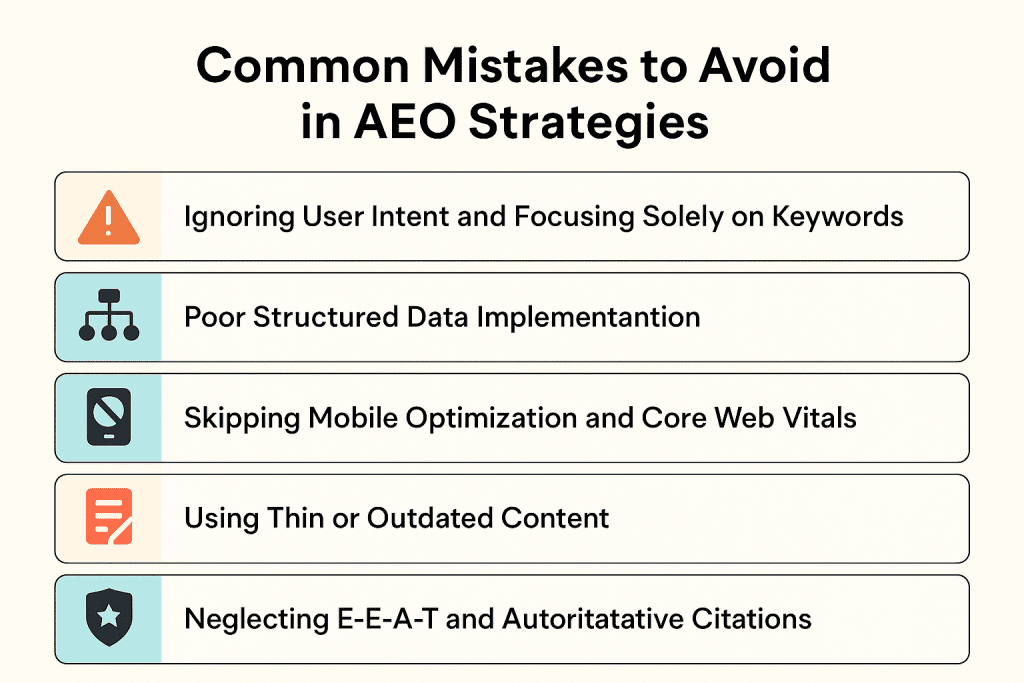
Even the most well-planned AEO Strategy can fall flat if you overlook some critical details. In 2025, avoiding these common missteps is just as important as implementing the right tactics. Let’s break down the pitfalls that can hold back your success and how to steer clear of them.
1. Ignoring User Intent and Focusing Solely on Keywords
AEO is about delivering the right answer — not just sprinkling in the right words. If your content targets keywords without addressing the actual question behind them, AI and search engines won’t consider you a trustworthy source. Always start with “What does my audience really want to know?” before thinking about keyword placement.
2. Poor Structured Data Implementation
Structured data is like a roadmap for search engines. If it’s missing, incomplete, or incorrectly formatted, AI may misinterpret your content — or skip it altogether. Follow Google’s Structured Data Guidelines to ensure your schema markup is accurate and complete.
3. Skipping Mobile Optimization and Core Web Vitals
Mobile-first indexing is here to stay. A slow-loading or unstable mobile page will hurt your visibility in AI search results. Prioritize Core Web Vitals: loading speed, interactivity, and visual stability.
4. Using Thin or Outdated Content
AI looks for comprehensive, reliable answers. Thin content or outdated facts signal low authority. Keep your pages updated with fresh, well-researched information — especially in fast-changing industries.
5. Neglecting E-E-A-T and Authoritative Citations
Experience, Expertise, Authoritativeness, and Trustworthiness (E-E-A-T) are core signals in AEO. Without citing authoritative sources, your content loses credibility. Reference respected industry sites, official publications, and government resources.
Pro Tip: Treat these mistakes as a checklist to audit your AEO Strategy every quarter. Preventing these errors not only boosts your rankings but also secures your place as a go-to answer in AI-driven search results.
Measuring the Success of Your AEO Strategies
Implementing an AEO Strategy is just the beginning — knowing whether it’s actually working is what keeps your efforts on track. Measuring success helps you fine-tune your approach, double down on what works, and fix what doesn’t before it costs you visibility. Here’s how to track real progress and make data-backed decisions.
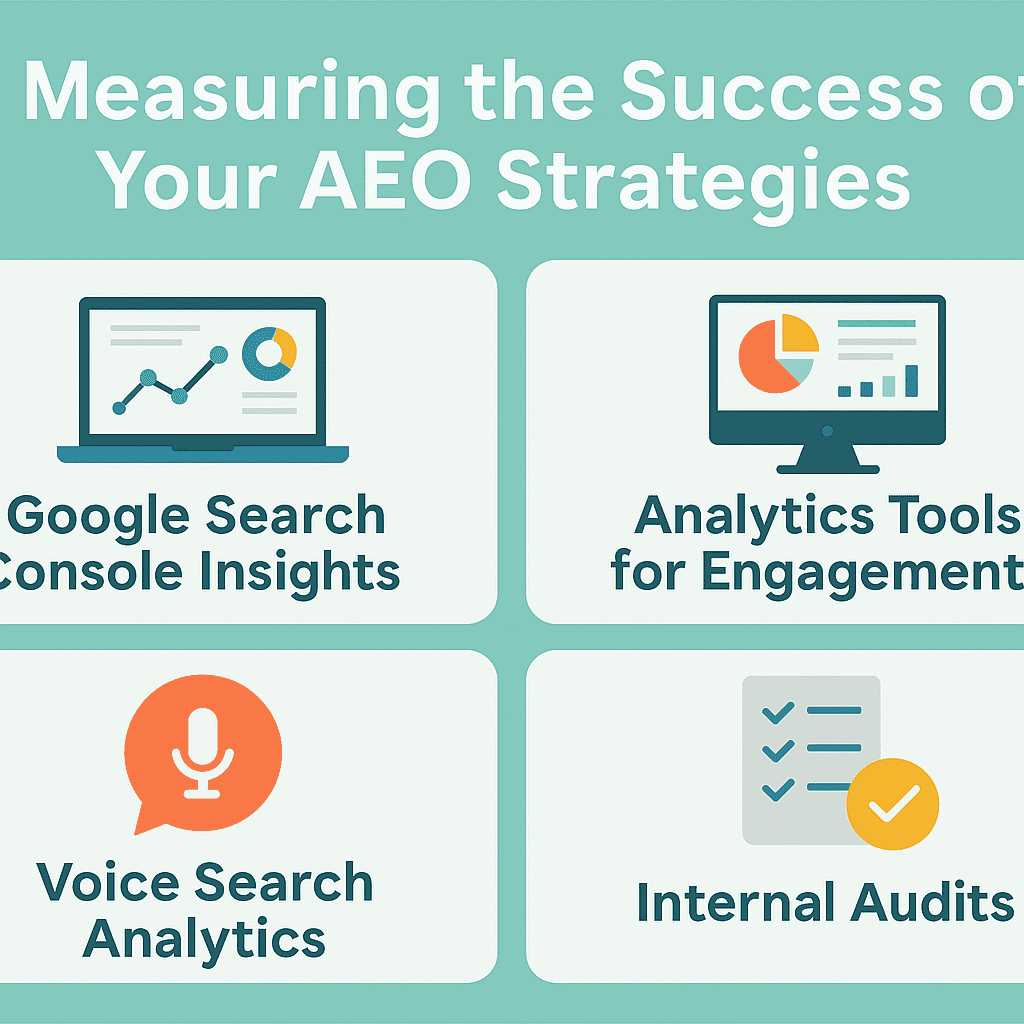
1. Google Search Console Insights
Your first stop should be Google Search Console. Keep a close eye on:
- Click-through rates (CTR): Are more people clicking your results after seeing them?
- Impressions: Is your content appearing for more relevant queries?
- Rankings: Are you moving closer to top positions or securing featured snippets?
(Tip: Pair this with our guide on Boosting CTR with Better Meta Titles and Descriptions for deeper optimization.)
2. Analytics Tools for Engagement
Use Google Analytics or similar platforms to measure:
- Engagement time: How long visitors stay on your page.
- Bounce rate: Are they finding what they came for, or leaving right away?
- Conversions: Are they taking action after engaging with your content?
3. Voice Search Analytics
As voice queries grow, track how many of your answers are delivered through AI assistants like Google Assistant, Alexa, or Siri. This can be done through third-party tools or assistant-specific dashboards.
4. Internal Audits
Quarterly audits keep your AEO content sharp. Review:
- Content structure: Is it still optimized for quick, clear answers?
- Schema markup: Is it accurate and up to date?
- Internal linking: Are you connecting to relevant topics, such as our The Rise of AI and Answer Engine Optimization cluster article?
External Authority Links:
6. Future Trends Beyond 2025
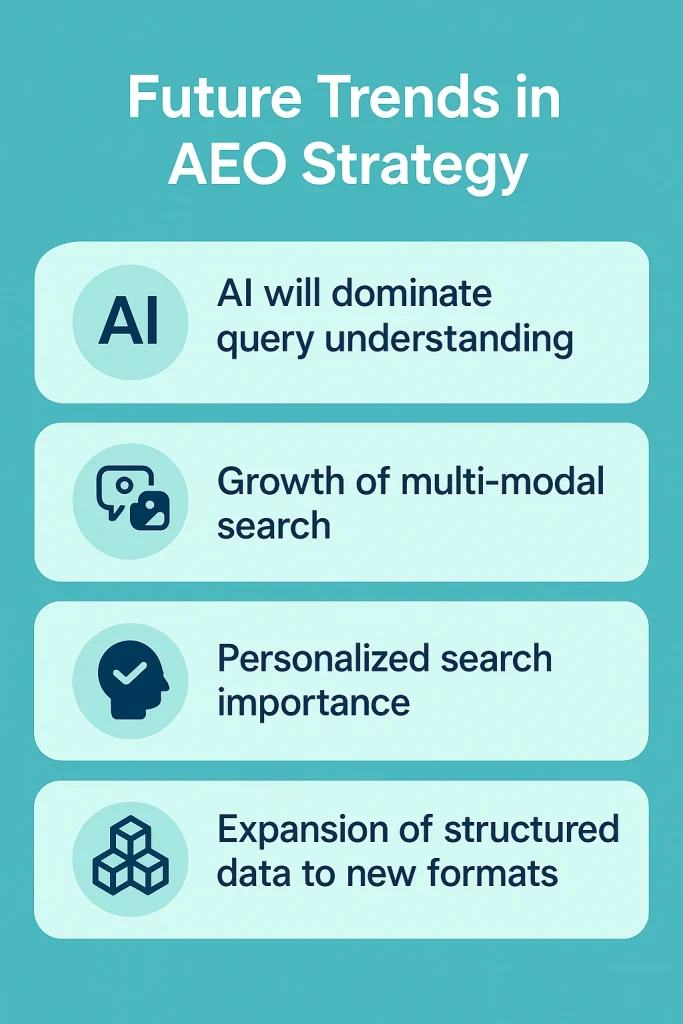
If you think the AEO Strategy landscape is changing quickly now, just wait until we move beyond 2025. The next wave of search innovation will demand even smarter, more adaptive approaches to stay ahead.
1. AI Will Dominate Query Understanding
Search engines will rely even more on advanced AI models to interpret user questions with context and nuance. Your AEO Strategy will need to deliver exact answers that align perfectly with intent, not just keywords. This means more structured, evidence-backed content and constant updates to maintain trustworthiness.
2. Multi-Modal Search Will Take Center Stage
We’re moving into an era where users expect to search using images, voice, and text in combination. Optimizing for multi-modal search means preparing content that’s visually rich, voice-search friendly, and textually clear — all in one package.
3. Personalization Will Shape Every Search
Search results will become more personalized, factoring in a user’s search history, location, and preferences. The stronger your alignment with audience intent, the more likely your AEO Strategy will secure those high-value, personalized placements.
4. Structured Data Will Expand
Expect schema markup to evolve for new content formats, from interactive video to augmented reality (AR) experiences. Early adopters who implement emerging schema types will have a clear advantage in search visibility.
Frequently Asked Questions (FAQs)
Q1: What is the difference between SEO and AEO?
Ans: SEO focuses on ranking for keywords, while AEO Strategies prioritize answering queries accurately for users.
Q2: Are AEO Strategies useful for voice search?
Ans: Yes, AEO Strategies align with conversational queries and featured snippets.
Q3: How do I measure the success of AEO Strategies?
Ans: Track engagement, CTR, rankings, and AI-generated search results.
Q4: Can structured data improve AI search results?
Ans: Absolutely, proper schema markup helps search engines understand and present your content.
Q5: Do AEO Strategies replace traditional SEO?
Ans: No, they complement SEO by focusing on intent and direct answers.
Q6: How often should content be updated for AEO Strategies?
Ans: At least quarterly, or whenever trends, algorithms, or user intent changes.
Q7: Which AI tools are best for optimizing content for AEO?
Ans: Tools like SurferSEO, Clearscope, and MarketMuse provide AI-driven recommendations.
Q8: Is mobile optimization critical for AEO Strategies?
Ans: Yes, mobile-first indexing makes mobile experience a ranking factor.
Final Thoughts: Strong Decisions from This Guide
By now, you’ve seen how a well-executed AEO Strategy can transform your visibility in the age of AI-driven search. These strategies aren’t just theoretical — they’re practical, measurable, and adaptable to every major change Google and other search engines throw at us.
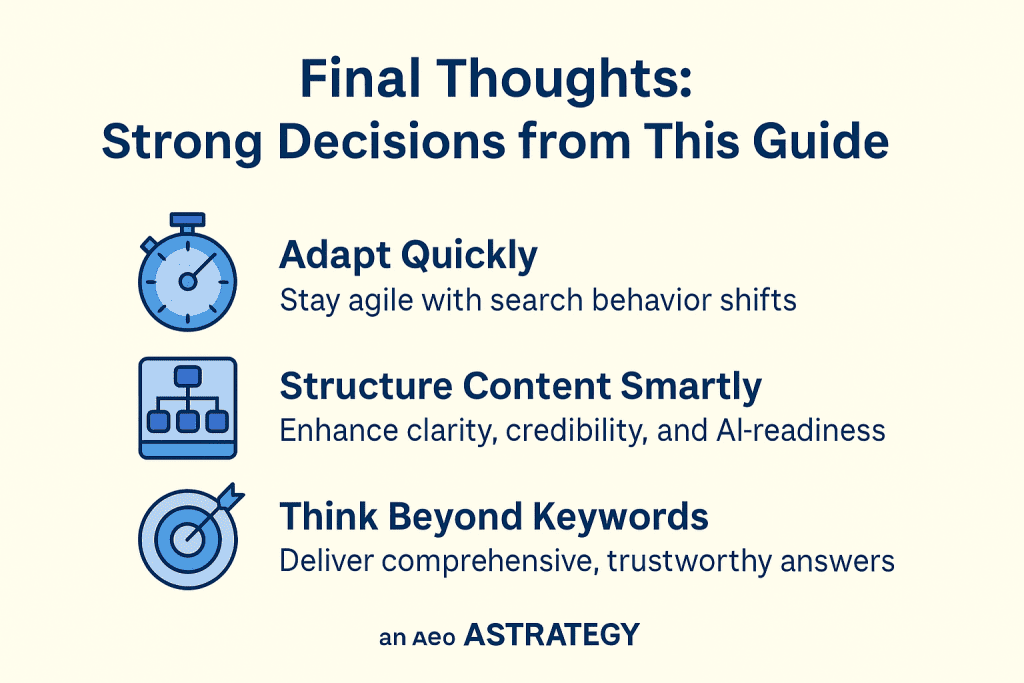
The real winners in 2025 and beyond will be the ones who:
- Adapt quickly to new search behaviors.
- Structure their content for clarity, credibility, and AI-readiness.
- Think beyond keywords and focus on delivering complete, trustworthy answers.
As Google Search Central notes:
“Ranking won’t be enough — being the authoritative answer will define success.”
That’s why it’s essential to not just apply these strategies once, but to continuously monitor, test, and improve them. The search landscape is dynamic, and your AEO approach should be too.
Call to Action: Take Your AEO Strategy to the Next Level
You’ve just learned how to craft a winning AEO Strategy that’s built for Tier-1 dominance in the AI-powered search era. Now it’s time to turn insights into action.
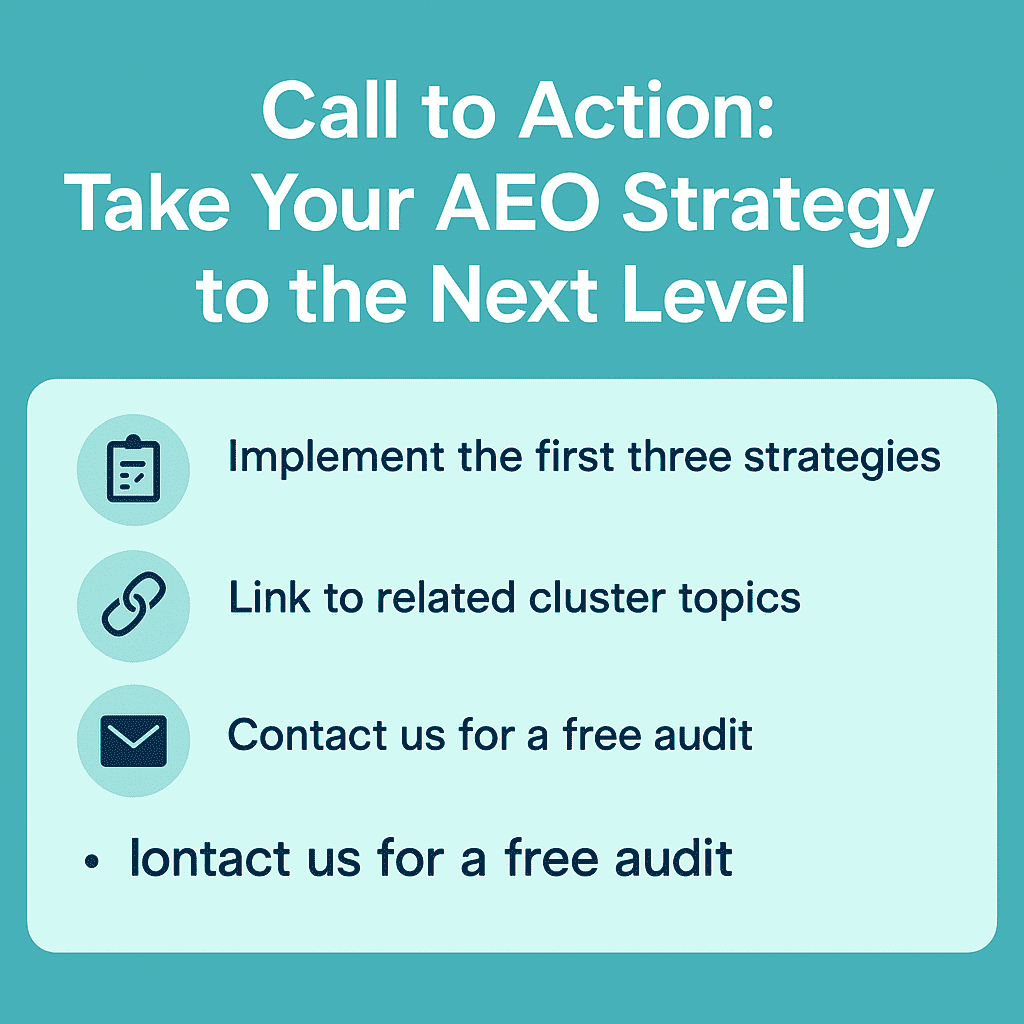
Start today by implementing the first three strategies — voice search optimization, structured data enhancements, and user intent targeting. These steps alone can create an immediate boost in visibility and prepare your site for AI-driven results.
For even stronger results, connect your new content to relevant cluster topics, like our Mastering AEO Strategies for SEO Dominance in 2025 guide, to strengthen your site’s topical authority. Internal linking isn’t just good SEO — it’s a signal to search engines that you own your niche.
If you’re ready to future-proof your SEO and dominate Tier-1 search results, contact us for a free AEO Strategy audit. We’ll evaluate your current performance, identify opportunities, and help you put a sustainable plan in place that works in today’s fast-changing search environment.
[…] In my experience following this local SEO guide strategy consistently increases map pack visibility, local impressions, and click-through rates. If you want to understand how entity optimization strengthens this process even further, see my internal resource: 7 Proven AEO Strategies to Dominate SEO in 2025. […]
Can you be more specific about the content of your article? After reading it, I still have some doubts. Hope you can help me.
Can you be more specific about the content of your article? After reading it, I still have some doubts. Hope you can help me. https://www.binance.com/register?ref=IXBIAFVY